London is one of the most competitive rental markets in the world. Each year thousands of students, young professionals and newcomers search for a room in the city — and the demand far outstrips supply in most areas. Prices are high and the best rooms go fast, but with the right approach and tools you can find your place without the usual stress.
This guide covers everything you need: where to look, what to expect to pay, how to avoid scams and how to use Hommis to find your room faster.
How much does it cost to rent a room in London?
Prices vary enormously depending on the area, room size and what's included. As a rough guide for 2026:
- Zone 1 (City, Westminster, Soho): £1,200–£1,800/month
- Trendy zones (Shoreditch, Brixton, Hackney): £1,000–£1,500/month
- Zone 2 (Clapham, Islington, Stoke Newington): £900–£1,300/month
- Zone 3–4 (Stratford, Lewisham, Tooting): £700–£1,000/month
- Outer zones (Croydon, Woolwich, Ilford): £600–£850/month
Most prices exclude bills (electricity, gas, water, broadband), which typically add £100–£150/month split between housemates.
Best areas by lifestyle
For students
Bloomsbury, King's Cross and Elephant & Castle are the classic choices — close to UCL, King's College, LSE and other major universities, well connected by tube and with plenty of student life. Slightly further out, Stratford offers better value with fast connections to the centre.
For young professionals
Shoreditch, Hackney and Peckham combine a creative, international atmosphere with good transport links. Clapham and Brixton are hugely popular for their social scene and community feel. If budget is a priority, Tooting and Streatham offer much better value.
For quiet and quality of life
Stoke Newington and West Hampstead are more residential, with leafy streets, independent cafés and a calmer pace — popular with professionals who want to stay connected but step back from the noise.
How to find a room in London without losing your mind
1. Define your search first
Area (or areas), maximum budget (including bills), move-in date and whether you want a room in a shared house or a studio. Having this clear saves a lot of time.
2. Use Hommis
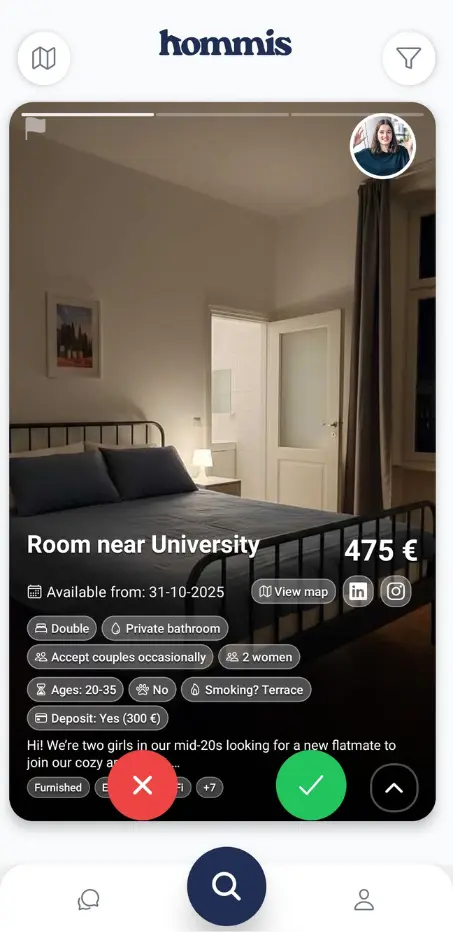
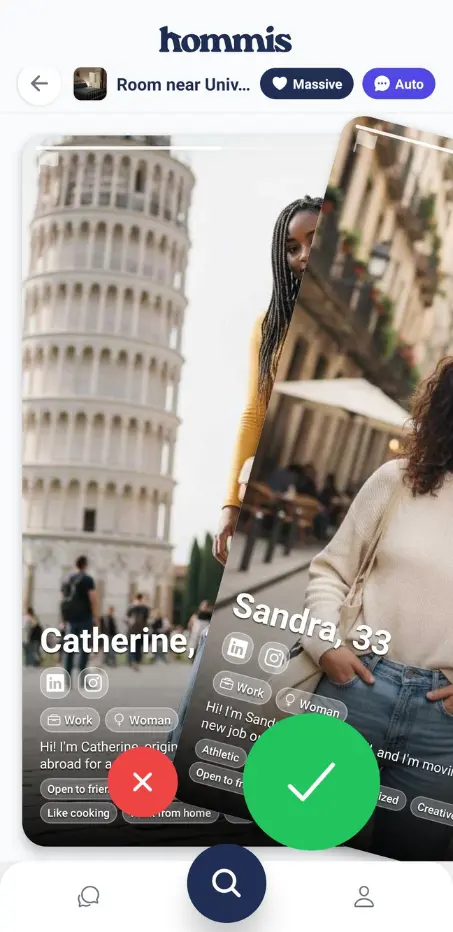
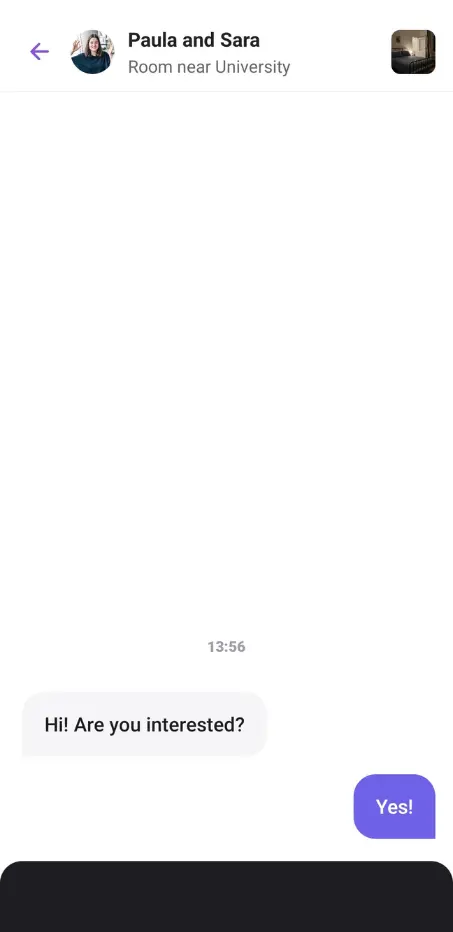
Hommis is a room-finding app that works like Tinder: you swipe through rooms and flats, right for yes, left for no. When you and the landlord both swipe right, a chat opens — direct, no agencies in between, no hidden fees. It's the fastest way to get genuine matches with people who already want to hear from you.
3. Move quickly
Good rooms in London go within 24–48 hours. If you see something that works, message the same day.
4. Always view before committing
Never sign or transfer money without seeing the room — in person or by video call. Check the room, the bathroom, the kitchen and ask the current housemates what the house is actually like.
5. Read the contract carefully
Make sure the contract includes: your name, the rent amount, what bills are included, the deposit amount, the notice period and conditions for leaving. If there's no written agreement, that's a red flag.
How to avoid rental scams in London
London has a well-documented problem with rental fraud. Watch out for:
- Prices far below market rate: A double room in Shoreditch for £500/month with a landlord "currently abroad" is almost always a scam.
- Requests for money before viewing: Legitimate landlords do not ask for deposits or advance payments before a viewing or a signed agreement.
- No video call or in-person viewing: If every excuse involves being overseas and wanting bank transfers upfront, walk away.
- Stolen photos: Run a reverse image search on the listing photos to check if they appear elsewhere.
On Hommis, all users must verify their phone number to list, which reduces fake profiles significantly.
What documents you'll typically need
- Valid ID or passport
- Employment contract or proof of income (last 1–3 payslips)
- University acceptance letter if you're a student
- References: from previous landlords or an employer
- Deposit: typically 4–5 weeks' rent (capped by law in England)
- Guarantor: sometimes required for students or those without UK credit history
Final tips
- Have documents ready: Landlords decide fast. Being able to share documents immediately gives you an edge.
- Complete your Hommis profile: A clear photo and honest description helps landlords trust you before the first message.
- Be direct in the chat: Tell them when you want to move in, your budget and one or two specific questions. Fewer messages, faster decisions.
- View several options: Don't take the first room out of desperation. Three to five viewings gives perspective.
Finding a room in London is competitive, but it is absolutely doable. Download Hommis on App Store or Google Play and start swiping today.