Living in Malta is simple on paper if you are an EU citizen, because it is an EU country that uses the euro. It is more demanding in practice, because you will need English and rent is usually your biggest expense. This guide covers what to know before moving to Malta: language, contracts, prices, areas and how to search from home.
Malta in 30 seconds
| Question | Answer |
|---|---|
| Is it a country? | Yes, independent and an EU member |
| Currency | Euro |
| Official languages | Maltese and English |
| Do you need to learn Maltese? | No. English is official and enough for leases and paperwork |
| Population | 574,250 at the end of 2024, according to the national statistics office |
Malta is a small and densely populated archipelago, and much of its growth comes from immigration. That explains why rent is the topic everyone talks about.
Why so many people from abroad choose Malta
- English: you can work and study in English without leaving the EU.
- English courses: Malta is a common destination for them, which creates a very international atmosphere.
- Work: igaming, tech, finance and hospitality attract many people from abroad.
- Size: distances are short, although traffic and the bus can make journeys longer than they look on the map.
- Climate: mild winters and very hot summers.
How renting works
The private residential leases law distinguishes between long contracts, short contracts and shared spaces. These are the rules that matter most when you arrive, according to the Housing Authority's FAQs:
- One-year lease: there is a minimum commitment period (di fermo) of six months. After that, the tenant can leave with one month's notice.
- Longer leases: notice is two months on a two-year lease and three months on a three-year lease.
- Shared spaces: they can be let for six months, and landlords can also offer longer contracts. Six-month contracts do not renew automatically.
- Deposit: it is not mandatory. The landlord decides whether to ask for one, and the amount must be stated in the contract and in the registration. If there is no deposit, it must be shown as 0.
Ask for the contract to be registered with the Housing Authority. It is one of the first questions to ask, because it protects you. The sources we consulted disagree on the exact registration deadline, so confirm it with the Housing Authority if you are unsure.
What it costs to rent
There is no single figure, and you should be wary of anyone who gives you one without saying where it comes from. These are the numbers we have been able to check:
| Data point | Figure | Source |
|---|---|---|
| New shared-space contracts, first half of 2025 | About one third, between €200 and €299 per tenant per month | Housing Authority, via Business Now |
| Two-bedroom flat in St Paul's Bay, median | €850 a month | Housing Authority, via Business Now |
| Two-bedroom flat in St Julian's, median | €1,500 a month | Housing Authority, via Business Now |
| Room, according to a 2026 student guide | €450 to €900 a month, more expensive in Sliema and St Julian's | Study Abroad |
Registered contracts include beds in shared rooms and contracts signed some time ago, which explains why they come out cheaper than many listings. For a realistic budget, look at current listings in the area you want and always ask what the price includes: water, electricity, wifi and maintenance can be extra.
Where to live in Malta
- St Julian's and Paceville: nightlife, offices and an international atmosphere. Usually among the most expensive areas, and noisy at night.
- Sliema: seafront promenade, shops and restaurants, with a more residential feel.
- Gżira and Msida: well located, close to Sliema and the university. Popular with people who want to be central without paying seafront prices.
- San Ġwann and Swieqi: residential and close to the office areas.
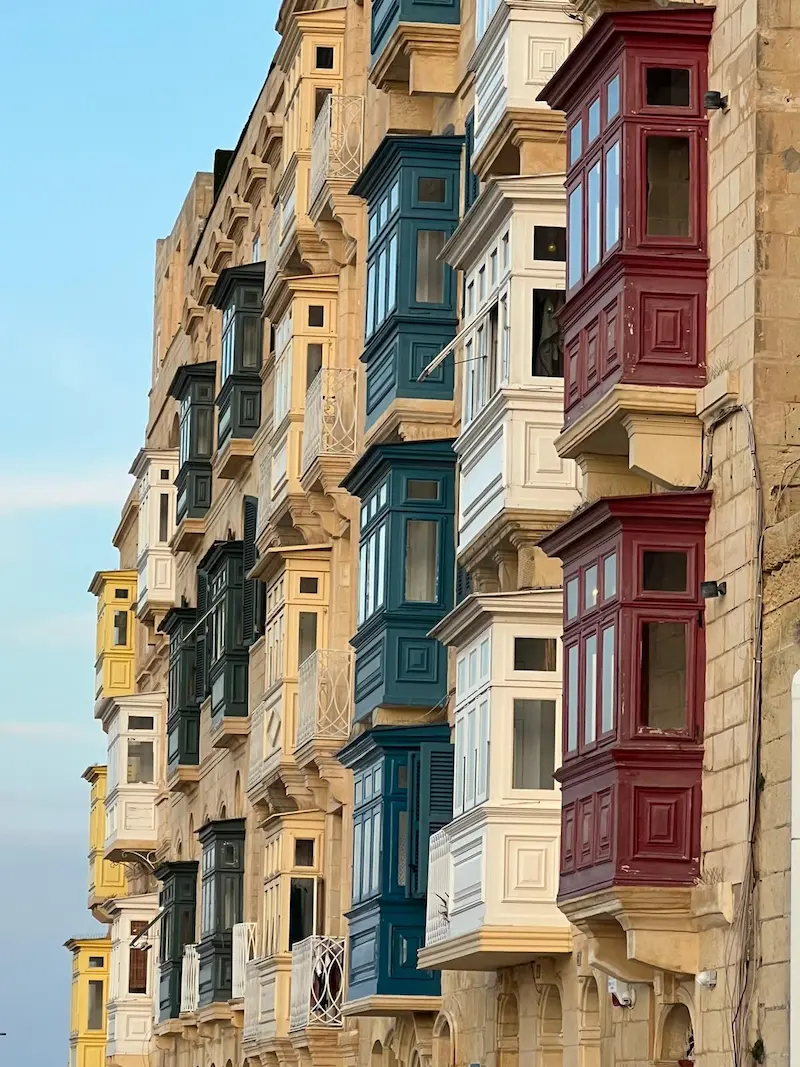
- Valletta: beautiful, but with fewer services for daily life.
- Birkirkara and Mosta: further inland, with more local life. If you work far away, check the commute carefully before signing.
- St Paul's Bay: the locality with the most active contracts, over 10,000 according to the Housing Authority, and cheaper than St Julian's.
- Gozo: quieter and further away. It only makes sense if your job or lifestyle does not depend on travelling to Malta every day.
Before you decide, try the real commute to work or school at rush hour. In Malta, three kilometres on the map are not always three kilometres by bus.
How to search for a room from abroad
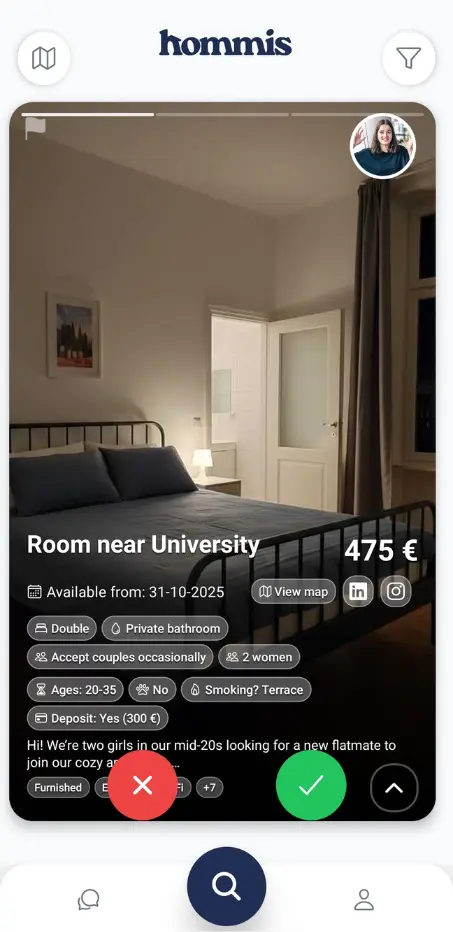
Good listings go quickly, so starting before you arrive helps. On Hommis you can do it like this:
- Download the app on iOS or Android. It is available in 12 languages, including English.
- Create your profile: say that you are looking in Malta, and add your budget and arrival date.
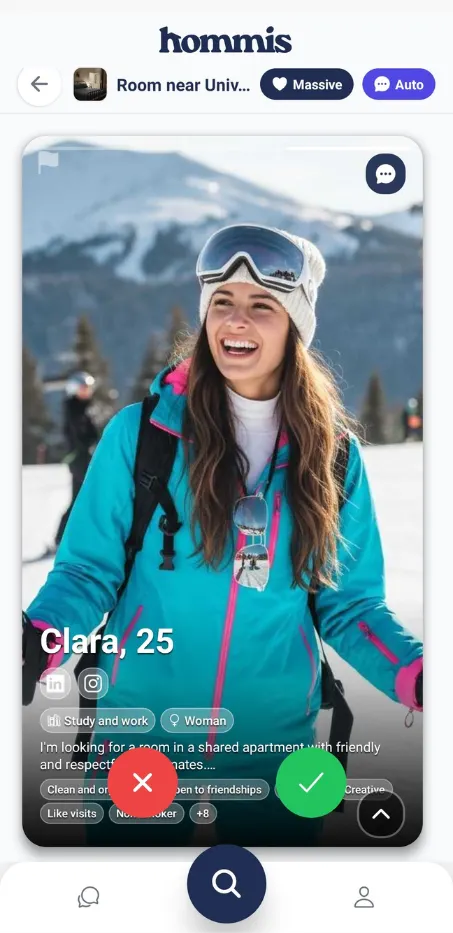
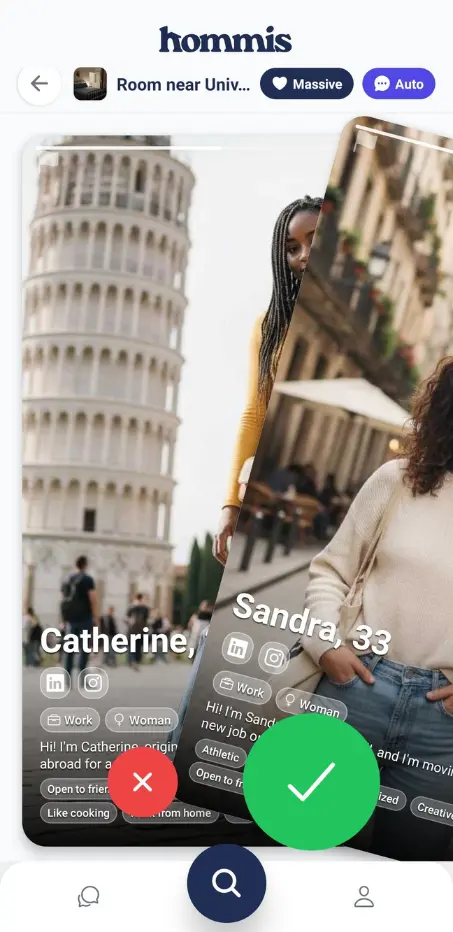
- Swipe on rooms and flats. People with a room to let also see your profile.
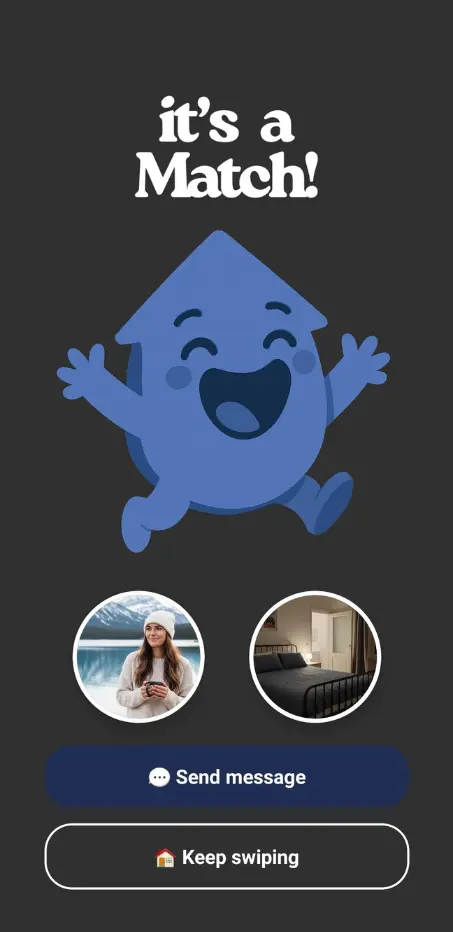
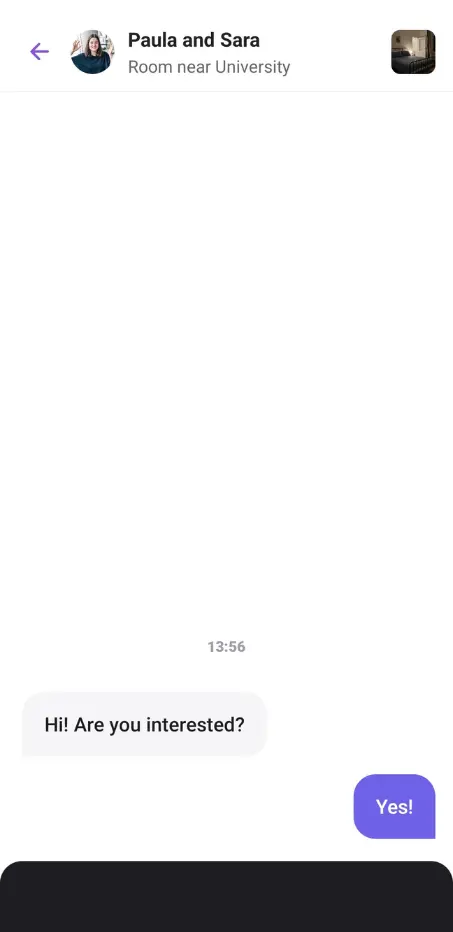
- Chat when you match: the chat opens once both sides have liked each other.
- Arrange a viewing, in person or by video call, before paying anything.
Searching, swiping, matching and chatting are free, and Hommis charges no commission. There is an optional Pro subscription, aimed mainly at people who post listings. People who post listings verify their phone by SMS, and you can report or block any user.
Hommis works in every country, especially in Malta and Europe, but it does not have to be your only option. For more choices, see our comparison of apps for finding a flat or room and the guide to finding a room in Malta as a foreigner. Many newcomers also use Facebook groups for expats or for people from their own country. Be especially alert to scams there.
Before you pay anything
- Do not send money to anyone before you have seen the room and have a contract.
- Ask whether the contract will be registered with the Housing Authority.
- Take photos and make an inventory when you move in, to avoid arguments over the deposit when you leave.
- Confirm what the price includes and how bills are split.
- Be wary of prices far below the area's level and of anyone who says they are abroad and will send you the keys.
Once you have a date, start searching from home with Hommis on the App Store or Google Play.
Last reviewed: 8 November 2026.